ON BOARD THE WALLA-B
On Board the Walla-B was made solo for my second year at University as part of a modding module aiming to demonstrate how we can quickly learn bespoke software made for specific games. The tools used for this project were built in a modified version of Unreal 3.
Responsibilities on this project included:
-
All Level Design (Documentation, Greyboxing and Polish)
-
Environment Design and Layout
-
Written Dialogue for Cutscenes and Flavour Text
-
Cutscene and Dynamic Music Set Up
-
Level Scripting
-
Quality Assurance and Testing
This project received very positive reviews, sitting at the front of the homepage of the Steam Workshop for several weeks, and for the season of it's release, remained at the top of the "Best in a 3-Month Period" category.

My goals for this project were to make a level of a difficulty and complexity that could be expected from DLC, but that only used pre-existing assets in the game, and to make the level simultaneously unique, but also fitting the aesthetic and tone of the original game.
The level is non-linear, made up of a central hub and a web of more linear challenges that unlock according to difficulty as the player progresses. These unlocks and the requirements for finishing the level are tied to collectibles rather than the actual completion of these sections meaning that more casual players can complete the level at their own pace, whilst more experienced players can seek out harder challenges.
See below, some of the planning documentation.
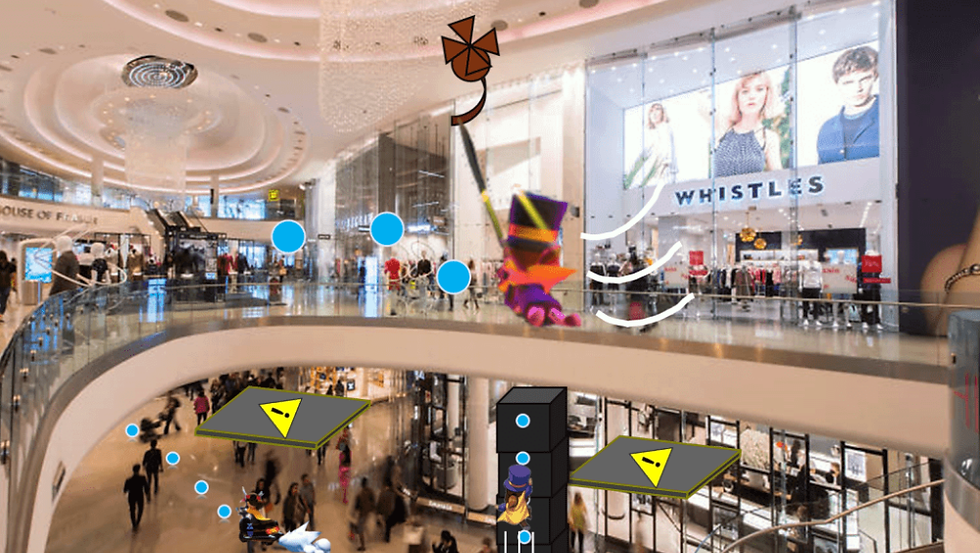
Early in this projects development we were expected to produce a project proposal. This image bash was made as part of that, as a form of crude concept art, both to illustrate to my lecturers what the level structure would be like, but also to use as a reference for myself. As a result, the level design depicted here, actually made it into the final mod.
The structure of the level aimed to be a small version of a larger world that one would find in a 3D collectathon platformer, with this atrium serving as a hub, so it was essential I got the basics of it correct.
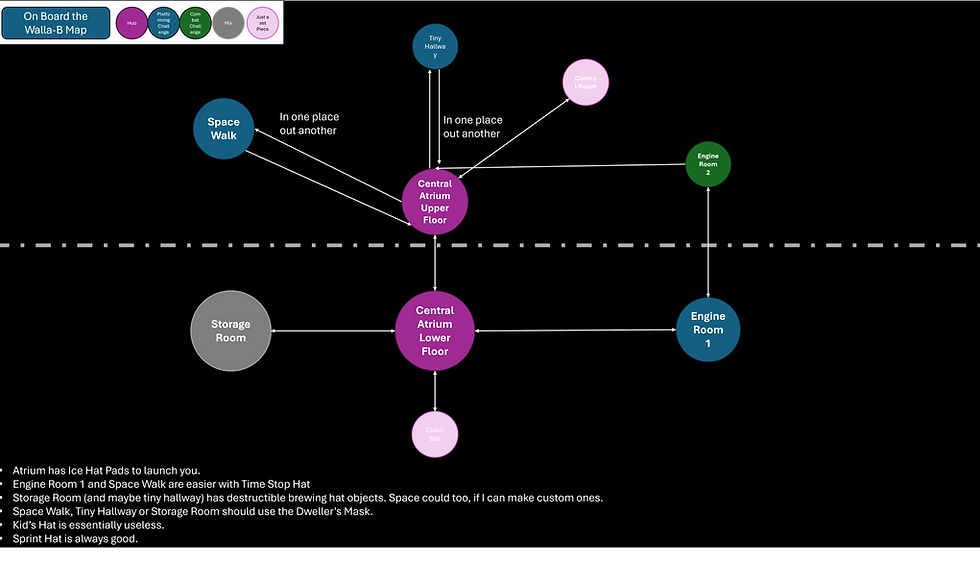
This node style map was made in order to plan how the different sections of the level would link together without needing to worry about the actual layout of the level. This meant I could focus on the progression experience without also needing to worry about physical space at the same time.
The levels layout consists of multiple linear platforming and combat sections that the player can approach in a semi-free order, all connecting back to the Atrium hub in the centre so this map was incredibly useful for the creation of the level.
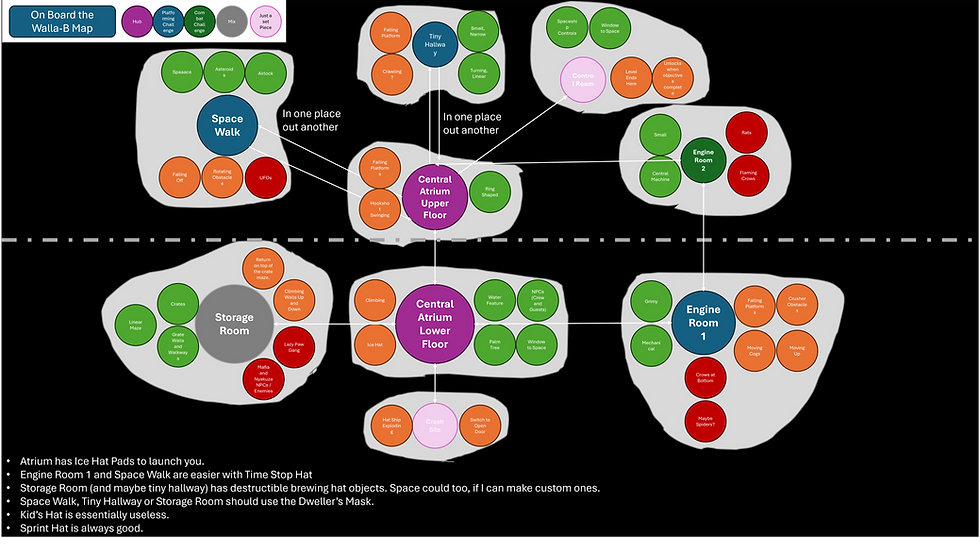
I returned to this map later in order to plan what obstacles, enemies and aesthetics each area would use. As this aiming to follow the structure of a DLC map, I could pull from all over the game, and I wanted to make sure there was not too much repetition.
The notes at the bottom of the page consider the character's abilities, as I wanted to give the player the opportunity to use all of them. By planning out the purpose of each area in this way, it made the actual creation process much easier, even without a map of each area, because I always had a goal in mind.
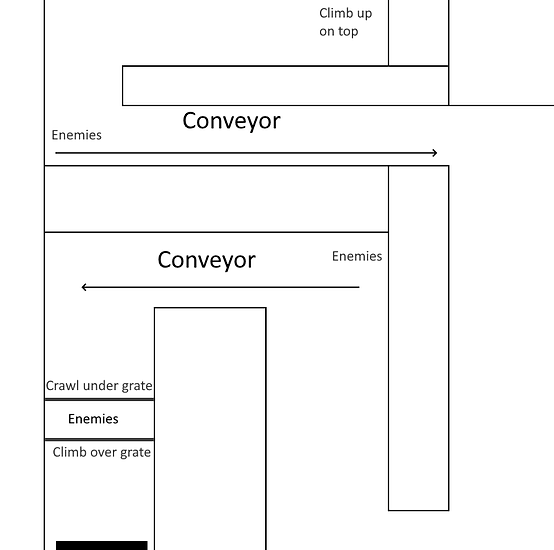
Some individual areas were mapped out to as part of the design process. When the Storage Room section of the level was not in a satisfactory state, and I was hitting a brick wall mentally, changing my design method design on paper first allowed me to refocus and identify the important parts of the design.
Revisiting the section in engine with this simple map made it significantly easier to complete.
Watch a playthrough of the level below. A version with developer commentary can be found here.
GALLERY


